
Some lives start quietly, with no signs of privilege or luck, yet end up inspiring the world. Omar Yaghi’s story is one of them.
He was born in 1965 in Amman, Jordan, to a Palestinian refugee family. His childhood was spent in a crowded home where water was scarce and electricity wasn’t guaranteed, but he grew up with a deep curiosity. His parents, who had little education, taught him that learning was the one thing no one could take away from him.
One day in a small library, young Omar saw a model of a molecule. Its shape and balance amazed him, and that moment sparked his love for science. As a teenager, he moved alone to the United States for school. He worked in a supermarket during the day and studied at a community college at night. From there, he transferred to the University at Albany, then earned a Ph.D. in chemistry at the University of Illinois.
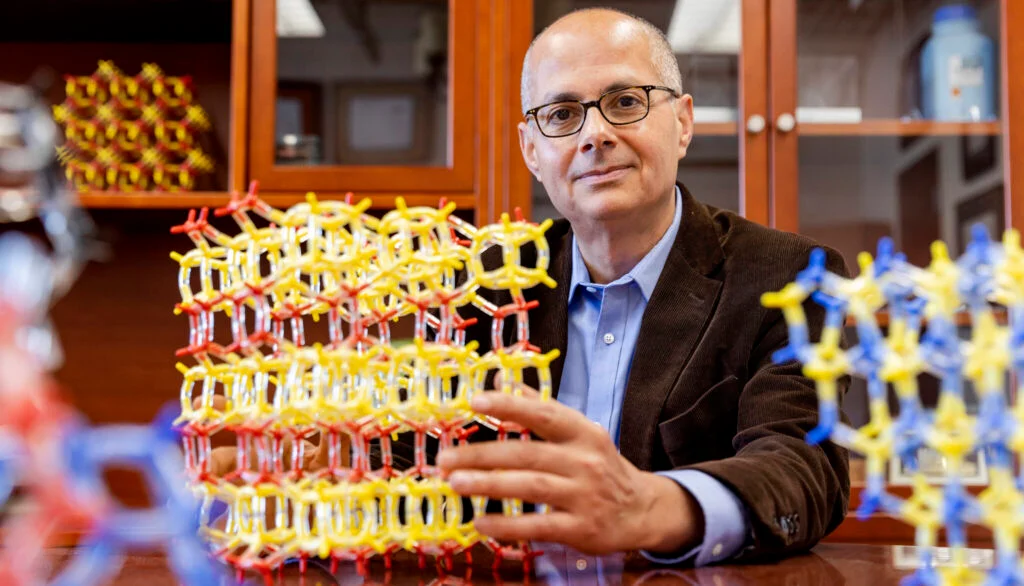
In the lab, Yaghi started imagining chemistry not just as finding things, but building things. That idea led him to create reticular chemistry and to pioneer metal–organic frameworks, or MOFs. These tiny structures are incredibly porous, so porous that one gram can have the surface area of several football fields. Scientists now use them for important work like pulling water from desert air, capturing carbon dioxide, filtering pollution, and storing clean energy.
In 2012, Yaghi joined UC Berkeley, a place he calls “the nirvana of science.” Surrounded by smart and ambitious students and researchers, he continued designing new molecular structures and teaching the next generation of scientists.
On October 8, 2025, he won the Nobel Prize in Chemistry for creating these new molecular architectures. Even then, he stayed humble, saying he only ever wanted to “build beautiful things.”
Omar Yaghi’s life shows that where you begin doesn’t decide where you end up. His journey is proof that curiosity can carry someone farther than circumstance ever could.