
The Nobel Prize in Literature is given for a writer’s whole body of work, not just one book. When the Swedish Academy chose the Korean author Han Kang last year, they praised the emotional strength of her writing and how bravely she deals with historical trauma. They said her stories show both the weakness and the strength of human life through simple, poetic language.
In her Nobel lecture, Han Kang asked two questions: “Can the past help the present? Can the dead rescue the living?” She said these questions have always guided her work as she tries to understand how memories of victims can shape the lives of those who survive.
Her newest book, We Do Not Part (English edition 2025), begins with quiet snowfall. The snow isn’t peaceful; it’s like memory, soft but heavy, hiding and revealing at the same time. The story centers on three women: Jeongsim, a survivor of the Jeju 4·3 Massacre; her daughter, Inseon; and Kyungha, the narrator. A small moment—the death of Inseon’s pet bird—pulls Kyungha deeper into the history the island holds. Through these women, Han Kang shows how grief can pass from one generation to the next.
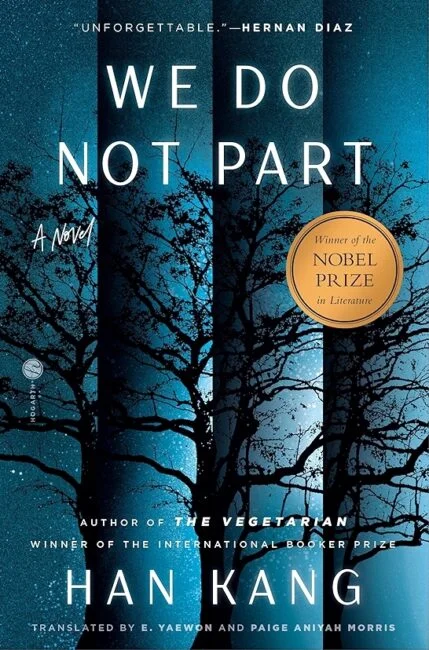
When the novel reaches the real events of the Jeju Massacre, the tone becomes calm but devastating. She never exaggerates the violence. Instead, she describes it with simple, controlled sentences that make it even more heartbreaking. She wants the reader to witness, not look away. Her restraint turns history into something personal, reminding us that every victim was once loved by someone.
Throughout the book, Han Kang uses nature (snow, birds, trees) as quiet symbols of memory and survival. Her writing is slow and clear, almost like she’s tracing the edges of silence. Instead of explaining everything, she lets readers feel the meaning for themselves.
Unlike her earlier novel Human Acts, which focuses on public grief, We Do Not Part looks inward. It asks how people continue living after the world has moved on. Han Kang shows that remembering is not just looking back but a daily responsibility.
By the end, the snow is still there, and the dead bird doesn’t come back to life. But in Kyungha’s mind, its wings still rise. That small image becomes the book’s final message: even in loss, there can be a spark that keeps moving forward. To remember is to care, and to care is to not let the past disappear.
Han Kang’s questions from her Nobel speech also echo in Korea’s recent history. When former president Yoon Suk-yeol illegally declared martial law last year, ordinary citizens stepped forward to defend the National Assembly, knowing what past tragedies had followed similar events. Their courage, and the Assembly’s decision to impeach him, showed how the memory of Jeju 4·3 and Gwangju still guides the living. In that sense, the victims of those tragedies continue to “rescue” the present.